Today is the day after San Martino, St Martin’s Day, one of the great dates in the Italian autumn calendar. It’s the time when the new wine is opened, the chestnuts are roasted in the street, and the old saying goes that at San Martino every must becomes wine. In Tuscany it is also the season of castagnaccio: a dark, dense, rustic chestnut flour cake that has fed the Apennine villages for centuries.
Here is the story of this humble cake, and a recipe for it, finished with a generous drizzle of chestnut honey.
What is castagnaccio?
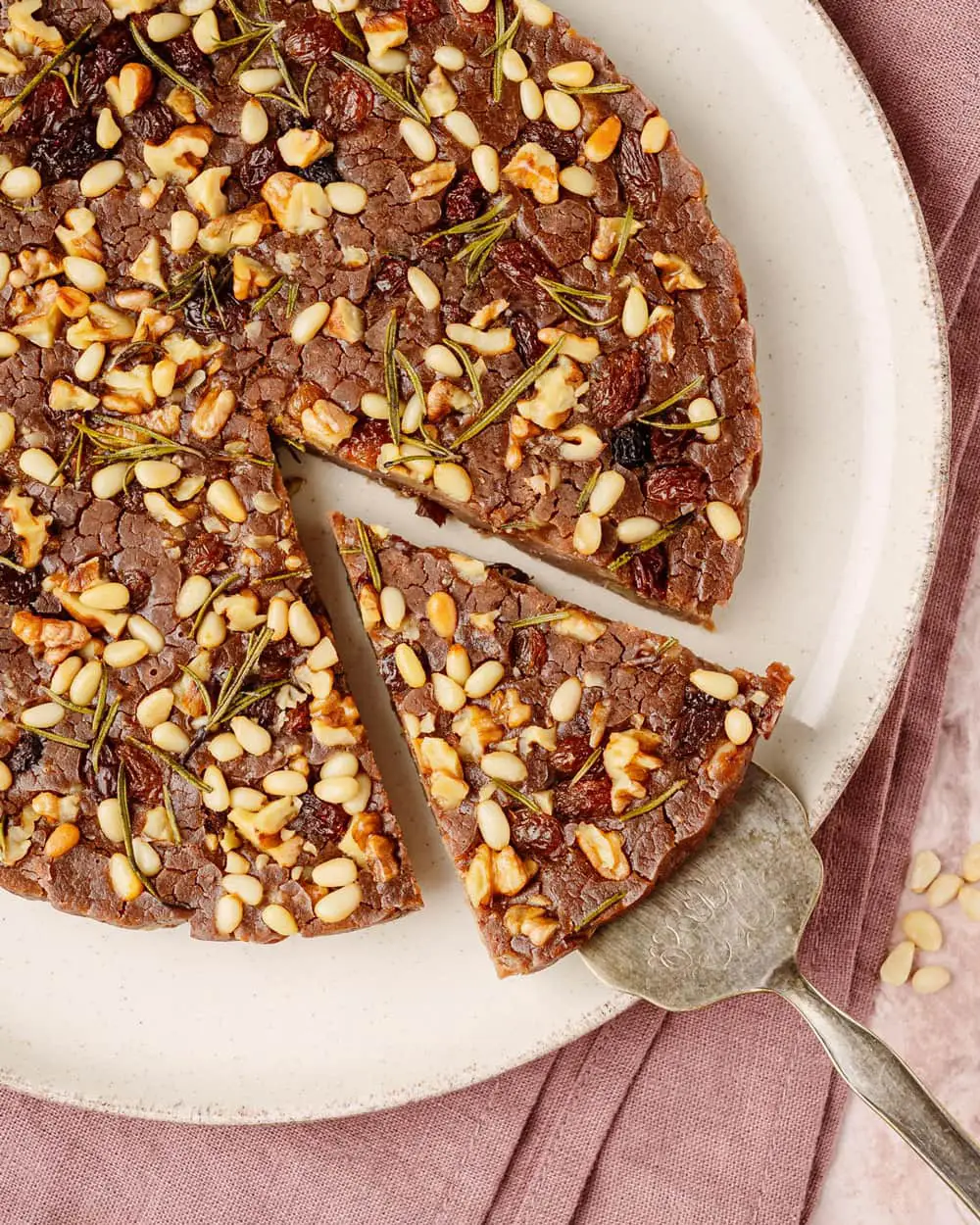
Castagnaccio is a traditional chestnut flour cake from Tuscany, and one of the oldest desserts in Italian cooking. It is flat, dense and deep brown, with a cracked, slightly crisp top and a soft, almost custardy middle. In its simplest form it needs only chestnut flour, water, a pinch of salt and a little olive oil. Raisins, pine nuts, walnuts and rosemary are added on top, giving it a nutty, resinous, slightly savoury character that is nothing like a sweet sponge.
It is naturally free of wheat flour, eggs, butter and added sugar. Its mild sweetness comes from the chestnut flour itself, which Italians call farina dolce, “sweet flour”, and from the raisins.
A cake born of poverty
In the mountain villages of the Apennines, the chestnut tree was known as the albero del pane, the “bread tree”. Chestnuts were dried, ground into flour and used in place of wheat, which was expensive and scarce. Castagnaccio was the result: a peasant cake made with what the woods and the olive grove provided. Accounts of it go back to the sixteenth century, and in the nineteenth century it spread across Italy, enriched with raisins, pine nuts and rosemary. It is also known by other regional names, such as baldino and pattona.
Why chestnut honey?
Traditional castagnaccio is unsweetened, which makes it perfect for a drizzle of honey. And no honey suits it better than chestnut honey. It is dark and aromatic, with a bold, slightly bitter edge and a long, woody finish, not the floral sweetness of most honeys. That bitterness is exactly what the cake needs: it echoes the chestnut flavour, balances the sweetness of the raisins and turns a simple slice into something much more complex.
Our Chestnut Honey, 500g is made by the Fabrizi family in the Marche region and won a gold medal at the London Honey Awards in 2019. Dark amber in colour, it is intense and aromatic, with a slightly bitter taste and notes of liquorice and smoke. It is just as good on a cheeseboard, drizzled over mature and blue cheeses such as Gorgonzola Piccante or Pecorino di Pienza Gran Riserva.
Castagnaccio recipe
Prep: 15 minutes, plus 15 minutes resting | Cook: 35-40 minutes | Makes one 24cm cake, serves 8
Ingredients
- 300g chestnut flour (farina di castagne), sold by good Italian delis, health food shops and online
- 400-450ml cold water
- A pinch of fine salt
- 3 tbsp Extra Virgin Olive Oil, Bono Salvatore, plus extra for the tin and for drizzling
- 50g raisins, soaked in warm water or, for a richer flavour, in 1 tbsp Vin Santo and a little warm water
- 40g pine nuts
- 40g walnuts, roughly chopped
- 1-2 sprigs of fresh rosemary, needles only
- 2-3 tbsp Chestnut Honey, Fabrizi Family, to serve
Method
1. Prepare the raisins. Soak the raisins for about 10 minutes, then drain and pat dry.
2. Make the batter. Sift the chestnut flour into a large bowl, as it clumps easily. Add the salt, then pour in the cold water a little at a time, whisking constantly to avoid lumps. Stir in 3 tablespoons of olive oil. The batter should be smooth and fairly runny, like a thick crêpe batter. Leave it to rest for 15 minutes, and add a splash more water if it thickens.
3. Heat the oven. Preheat to 190°C (170°C fan). Brush a 24cm round tin generously with olive oil.
4. Fill the tin. Stir about half the raisins, pine nuts and walnuts into the batter, then pour it into the tin. The batter should be about 1.5cm deep. Scatter the remaining raisins, pine nuts and walnuts over the top, add the rosemary needles and finish with a drizzle of olive oil.
5. Bake. Bake for 35-40 minutes, until the surface has darkened and cracked, the edges are crisp and pulling away from the tin, and the centre is set. The top should look dry but not burnt.
6. Serve. Leave to cool slightly, then cut into wedges and drizzle with chestnut honey. It is best warm or at room temperature.
A note from the kitchen: the quality of the flour makes or breaks castagnaccio, so choose a fresh, finely ground chestnut flour, with a sweet, nutty aroma. Don’t skip the rest, as it lets the flour absorb the water and gives a smoother texture. For a fresher, more aromatic edge, add a little grated orange zest to the batter, though this is a modern variation rather than the strictly traditional way.
How to serve castagnaccio
- The classic way: a warm wedge with a thread of chestnut honey.
- With ricotta: a spoonful of fresh ricotta on the side balances the earthy density.
- On a cheeseboard: serve small pieces with Pecorino di Pienza Gran Riserva or Gorgonzola Piccante and a drizzle of chestnut honey, a classic Tuscan contrast of sweet, salty and bitter.
- With a glass of Vin Santo: its notes of honey, hazelnut and dried fruit are a natural match. Our Vin Santo DOC 2011, Colombaio di Cencio is aged for over ten years in small barrels and is a good partner for a slice.
- Storage: keep it covered at room temperature for 2-3 days. It becomes firmer in the fridge, which is normal.
Frequently asked questions
Is castagnaccio gluten-free?
It is made without wheat flour, so it is naturally gluten-free. If you need to be sure for coeliac guests, check that your chestnut flour is labelled gluten-free.
Is castagnaccio vegan?
The cake itself is made without eggs, dairy or butter, so it is naturally vegan. Honey is not vegan, so skip it or use another topping if you need a fully vegan version.
Does castagnaccio contain sugar?
The traditional recipe has no added sugar. The sweetness comes from the chestnut flour and the raisins, and from the honey if you add it.
What is chestnut honey?
A dark, aromatic honey made by bees from chestnut tree blossom. It has a bold, slightly bitter flavour, and is excellent with aged cheeses and on desserts such as castagnaccio.
Why is my castagnaccio cracked?
It is supposed to be. The cracked surface is a sign of a well-baked castagnaccio.
Shop the recipe